The pricing models at a glance
| Model | What you pay for | Available for (vendor's words) | Published list price |
|---|
| Workload | "The amount of compute and storage resources required to run search and analytics workloads", in SVCs on Cloud and vCPUs on Enterprise | Cloud Platform, Enterprise, Enterprise Security, ITSI | No |
| Ingest | "Gigabytes of data ingested into Splunk" a day | Cloud Platform, Enterprise, Enterprise Security, ITSI | No |
| Activity-based | "A dual-meter pricing model based on both ingest and search activity" | Cloud Platform | No |
| Entity | "The number of monitored hosts, containers, and protected devices" | Observability Cloud and AppDynamics, not the SIEM | Observability from $15 per host a month |
Source: the vendor's pricing models and platform pricing pages, accessed 23 September 2026.
Cloud Platform and Enterprise pricing both include unlimited users. Entity pricing and the $15 figure apply to observability, not to security, so ignore them when you price a SIEM.
How each part of the bill works
Workload pricing and SVCs
The Cloud Platform service details (updated 6 March 2026) define the unit. A Splunk Virtual Compute (SVC) is "a unit of capabilities in Splunk Cloud Platform that includes compute, memory, and I/O resources". The same page says your subscription "is workload-based and is sized for resource capacity".
Under workload pricing, ingestion is not metered. In the vendor's words, "workload-based subscriptions do not meter ingestion. You can increase ingest and/or search load and operate the service to your desired performance objective until the SVC entitlement of your subscription reaches full utilization." So the cost driver is how hard you work the platform: more searches, more correlation, more dashboards and more data all consume SVCs.
The vendor says workload pricing is best suited to "storing data that is searched and analyzed infrequently". A security team running correlation searches all day is the opposite case, so model SVC use carefully.
The official pricing calculator takes a workload type and your daily GB and returns an estimated number of SVCs. It does not return a price.
Ingest pricing
Ingest pricing charges for "gigabytes of data ingested into Splunk" a day. On the cloud platform, an ingest subscription still comes with compute: "SVCs are allocated to your subscription plan based on your ingest-based subscription (GB/day), up to the maximum of 1 SVC for every 10 GB/day." A 150 GB a day subscription therefore gets up to 15 SVCs.
The overage rule is specific. On an ingest subscription, "you can exceed your purchased daily index volume a maximum of five times in a calendar month". The pricing FAQ adds that it only charges for overages "when you consistently exceed your purchased data ingestion or storage capacity".
One discount is written into the pricing pages. Eligible Cisco telemetry counts at a "0.5x weighted ingest rate" on the cloud platform, and at 50% on the self-managed product.
Enterprise (self-managed)
The Enterprise edition is the version you run yourself, in a private cloud or on premises. It is sold on ingest or workload pricing, with workload measured in vCPUs. The licence is only part of the cost: you also pay for the servers, storage and people that run indexers and search heads.
Enterprise Security editions
Enterprise Security (ES), the SIEM layer, comes in two editions, both by quote:
- Essentials includes the SIEM, threat intelligence, Detection Studio, exposure analytics and AI features.
- Premier adds SOAR, user and entity behaviour analytics (UEBA) and automated threat analysis.
If you need automated response or UEBA, price Premier, not Essentials.
Storage and retention: where the hidden costs sit
The cloud platform splits storage into several products. Each has different search rules, and the rules matter as much as the price.
| Storage | What it is | Can you search it where it sits? | Source |
|---|
| Searchable storage (DDAS) | "The primary entry point for newly ingested data" | Yes | Service details |
| Active archive (DDAA) | Vendor-managed archive for data past searchable retention | No: restore first. Restored data is searchable "within 24 hours" and "for up to 30 days" | Service details; archive documentation |
| Self-storage (DDSS) | Aged data exported to your own AWS S3 or Google Cloud Storage | No: it "will no longer be searchable by Splunk Cloud Platform" | Service details |
| Federated Search for Amazon S3 | Search over data in your own S3 buckets | Yes, on a separate licence of Data Scan Units | Federated search documentation |
The archive documentation adds two limits. "The restoration process can take up to 24 hours to complete." And the vendor "will block you from restoring large amounts of data" that could affect performance. Ask how much you can restore at once before you rely on the archive for investigations.
Federated Search for Amazon S3 is licensed separately from SVCs and ingest. You buy Data Scan Units for the data you expect to scan in a year, and "each DSU is equivalent to 10 TB of data scanning capabilities". It is available only on cloud deployments in AWS regions.
The practical effect: a threat hunt that reaches past your searchable retention starts with a restore request or a separately licensed scan. Size searchable retention for the longest window you expect to investigate, not only for compliance.
Free options
There are free trials of the cloud and self-managed products, and a Free licence, which "allows you to index 500 MB per day" on a single instance. It is for learning, not security operations: "Alerting (monitoring) is not available", there are "no users or roles", and search is disabled after repeated licence violations.
How to read a quote
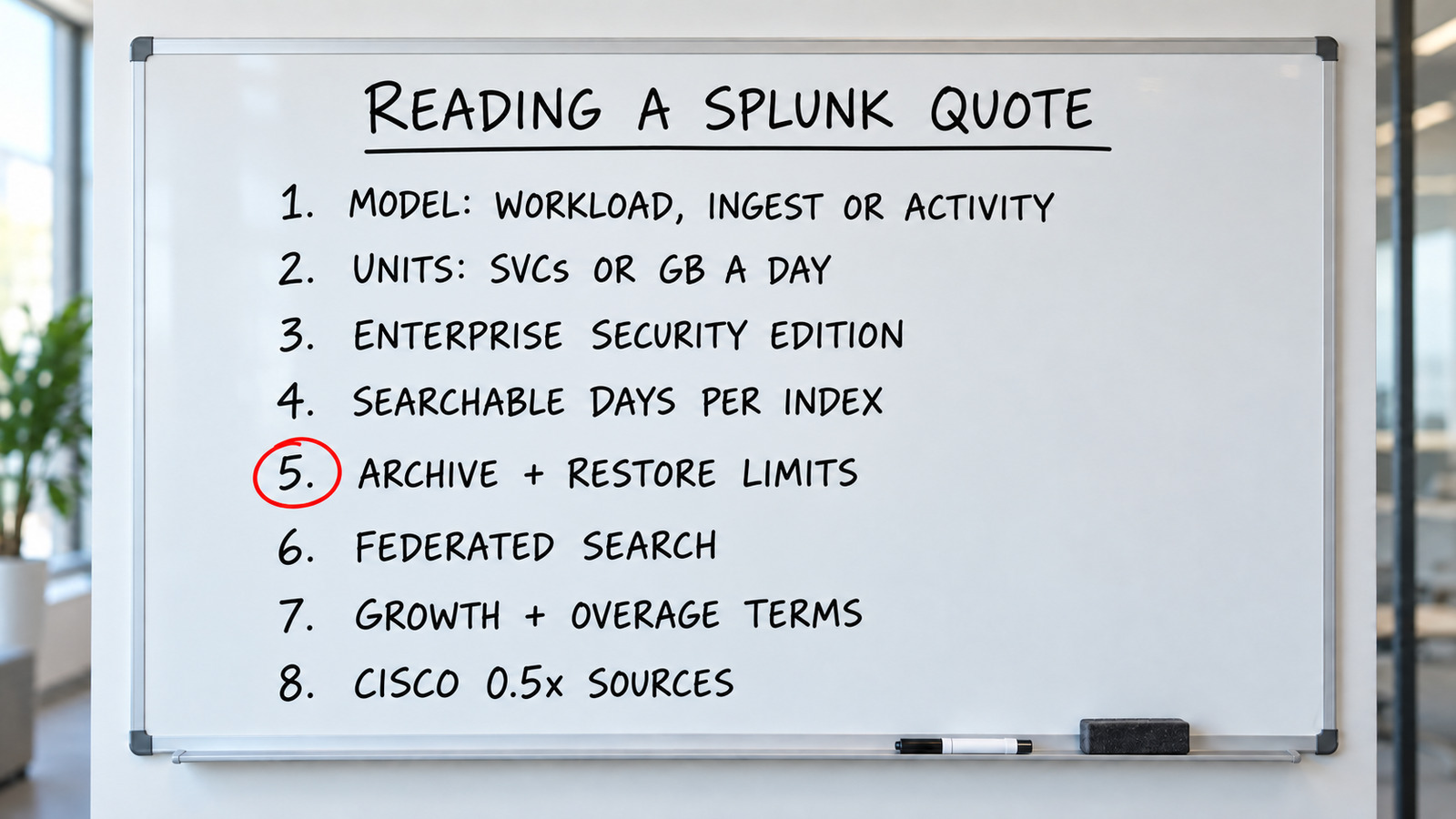
The eight lines to ask for on any Splunk quote. Archive and restore limits are circled because they are where the hidden costs sit.
Because there is no list price, the useful work is making two quotes comparable. Ask for these line by line:
- The model. Workload, ingest or activity-based, and why that model suits your search load.
- The unit count. SVCs or vCPUs for workload; GB a day for ingest. For ingest, confirm how many SVCs come with it.
- Enterprise Security edition. Essentials or Premier, and whether SOAR and UEBA are included.
- Searchable retention. Days of searchable storage per index, and the price of extending it.
- Archive and restore. Whether DDAA is included, how much you can restore at once, and how long restored data stays searchable.
- External data. Whether Federated Search is included, and how many Data Scan Units.
- Growth terms. What happens at renewal if your volume or search load grows by half, and how overages are billed.
- Cisco weighting. Which of your sources qualify for the 0.5x ingest rate.
Then add the costs outside the licence line: infrastructure if you self-manage, professional services, and the engineers who write and tune SPL detections. Our SIEM cost calculator sets your quote against Microsoft Sentinel's list price and an indicative SenseOn figure.


